
Program Compliance
at CARES of NY, Inc.
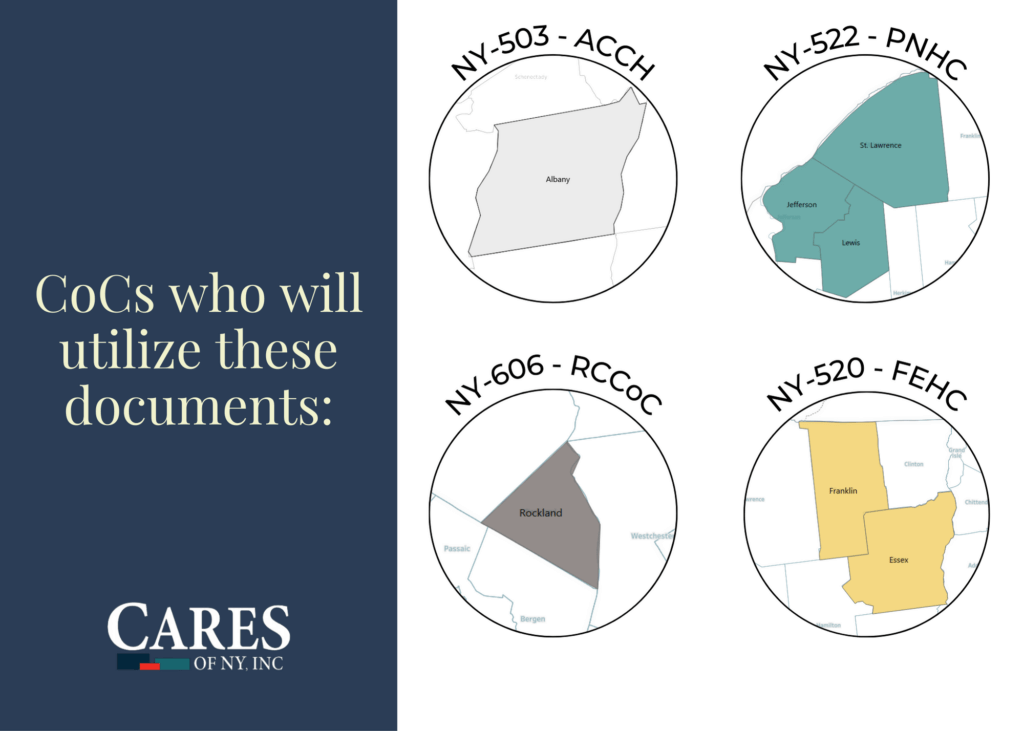
UFA Designated CoCs
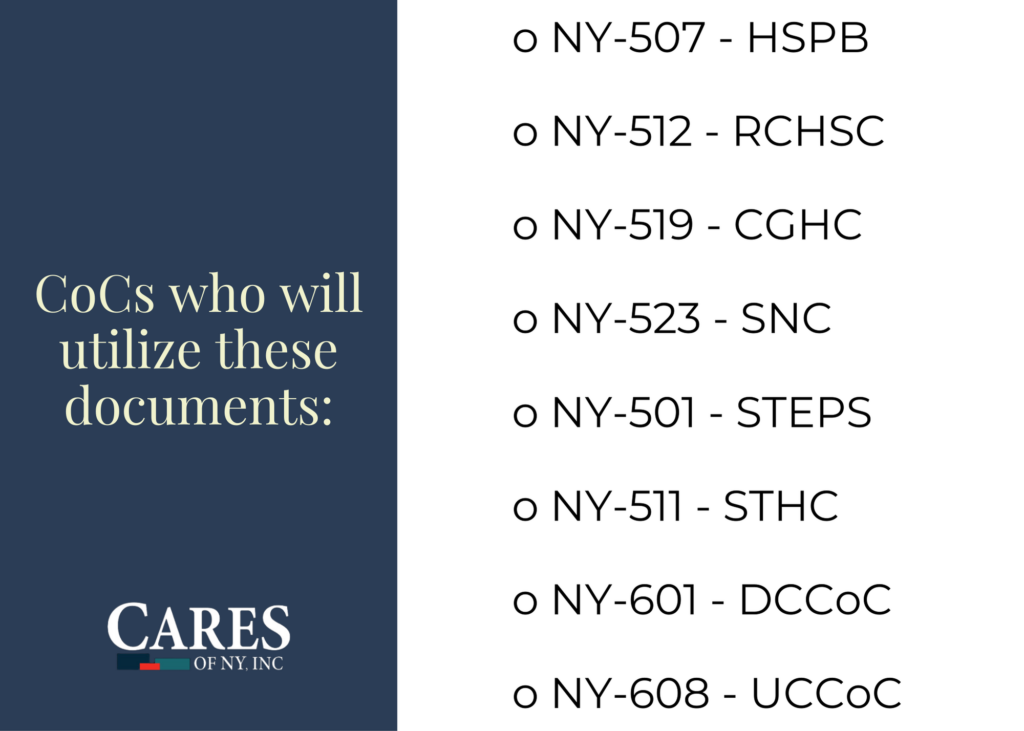
CoCs Not Designated UFA



- What is the criteria for PSH projects?
- The criteria for HUD CoC Permanent Supportive Housing (PSH) projects must have a household member with a disability
- Permanent Supportive Housing (PSH) is permanent housing in which housing assistance (e.g., long-term leasing or rental assistance) and supportive services are provided to assist households with at least one member (adult or child) with a disability in achieving housing stability.
- Disability verification is only required at the participant’s project entry into PSH and does not need to be recertified for the person to continue receiving assistance. *Recipients and subrecipients have 45 days to obtain the documentation of disability at project entry into PSH as long as there is intake worker observation that a disability is present.
- **Please note: Intake staff may record their observations of a disability as long as it is confirmed by the standards above within 45 days of the application for assistance. If the recipient or subrecipient does not have the appropriate documentation within 45 days, the funds to serve that participant are no longer eligible costs for the CoC Program-funded grant. Disability may never be documented based on oral third-party reports or self-certification by the potential program participant. Disability Definition – CoC At A Glance – Virtual Binders
- If written verification is used to document a participant’s disability for program eligibility, the documentation must be signed by a licensed medical professional qualified to diagnose and treat the condition in New York State (NYS). In NYS, the following credentials are authorized to diagnose mental health conditions: Psy.D, MD, NP, PA, PNP, PMHN, APRN, LCSW, LMSW (when supervised by an LCSW or MD), and CRC. For substance use disorders, in addition to the aforementioned professionals, diagnosis can also be made by CASAC and CATC-certified medical professionals.
Permanent Supportive Housing Forms
2. How do I calculate PSH/TH tenant rent portion?
- When rental assistance is provided as part of a Transitional Housing (TH) or Permanent Supportive Housing (PSH) project, program participants receiving rental assistance are required to pay rent.
- For PSH and TH projects, the program participant’s rent cannot exceed the highest of the households:
- 30% Adjusted Monthly Income
- 10% Monthly Gross Income
- The portion of the households welfare assistance, if any, that is designated for housing costs
- Projects that provide Rental Assistance to program participants must charge rent that is the highest of these three figures. In these cases, the program participant’s contribution is paid straight to the landlord and the recipient pays the landlord the difference of the program participant’s contribution and the contract rent.
- Projects that support housing with leasing funds do not have to charge an occupancy charge (which is similar to rent), but if they do, they are not permitted to charge any amount higher than the highest of these three figures. In these instances, the recipient pays the landlord 100 percent of the rent and collects the occupancy charge from the program participant.
CoC Rent Calculation – Charging Rent – HUD Exchange
3. How do I calculate RRH tenant rent?
- RRH projects are not obligated to charge participants rent or an occupancy fee. However, if a RRH chooses to charge participants a portion of rent, it must do so in compliance with the projects designated CoC’s Written Standards. Please review your specific CoC’s Written Standards for calculating RRH tenant rent. CoC Rent Calculation – Charging Rent – HUD Exchange
4. What is FMR? What role does it play in CoC funded projects?
- FMR also known as Fair Market Rent is the HUD established estimates of gross rent, taking into account both rent and the cost of necessary utilities of a given area. FMRs are based on a standard calculation, updated annually and are published on HUDUser.gov. CoC projects with leasing funds are not permitted to exceed the FMR. Please note, FMR may adjust annually, please check the HUD User website annually. Rent Reasonableness and Fair Market Rent Under the Continuum of Care Program
5. What is Rent Reasonableness?
- HUD’s rent reasonableness standard ensures that rents being paid are reasonable in relation to rents being charged for comparable unassisted units in the same market. HUD’s sample rent reasonableness document compares the proposed unit to three unassisted units in the geographical area. While rent reasonableness is required for projects receiving leasing or rental assistance funds, the key distinction is that projects with leasing funds are bound by FMR limits, whereas projects with rental assistance funds may go beyond the FMR as long as the proposed unit is reasonable compared to the 3 other units.
- Please see link here for further information: Rent Reasonableness and Fair Market Rent Under the Continuum of Care Program
- Please see link here for SAMPLE Rent Reasonable Form: RENT REASONABLENESS CHECKLIST AND CERTIFICATION
6. When does an HQS inspection need to be completed?
- HQS inspections must be completed prior to the start date of a program participant’s lease/occupancy agreement and payment to ensure the unit meets the minimum health and safety requirements set by HUD. CoC Leasing and Rental Assistance Requirements – Codes and Standards – HUD Exchange
7. Are leases required to have term dates?
- Yes, PSH, RRH, and TH projects all require term dates for leases/occupancy agreements.
- PSH and RRH projects leases/occupancy agreements must have an initial term of at least one year, with automatic renewal upon expiration. After the one-year initial term, these agreements can transition to month-to-month terms. *Even if the rental assistance provided to the program participant is for less than one year, the tenant must still hold a one-year lease.
- TH project leases/occupancy agreements must have an initial term of one month, with automatic renewal upon expiration.
Please see link for further information: CoC Leasing and Rental Assistance Requirements – Lease Structure – HUD Exchange
8. What needs to be in a lease?
- Lease start date, lease end date
- Tenant and Landlord signature and date
- Address of the unit
- Security amount
- Monthly leasing amount
- Automatically renewable upon expiration, except by prior notice by either party
- If applicable, utilities included/excluded
CoC Leasing and Rental Assistance Requirements – Lease Structure – HUD Exchange
9. Can we pay utilities: RRH/TH/PSH?
- Rapid Rehousing: Must refer to specific CoC Written Standards
- Permanent Supportive Housing and Transitional Housing: If utilities are not included in the rent but are the responsibility of the resident, a utility allowance for reasonable utility consumption must be subtracted from the rent. CoC recipients are required to use their local Public Housing Authority’s (PHA) schedule of utility allowances per Notice CPD-17-11.
- If the cost of utilities is less than the permitted monthly rental amount, the amount of rent must be reduced by the cost of utilities.
- If the cost of utilities is greater than the permitted monthly rental amount, the household should receive a utility reimbursement
- Telephone, internet and cable television are ineligible utilities.
10. When does Monitoring/Compliance Review occur?
- Typically, CARES conducts its CoC/ESG/STEHP/HOPWA Monitoring/Compliance Review in the Spring/Summer.
11. What is PII and PII Training?
- PII (Personally Identifiable Information) refers to any data that can be used to identify a specific individual, either on its own or when combined with other information. It is critical to protect PII to ensure privacy and security, especially in programs dealing with sensitive client information like those administered by HUD or other agencies.
- Examples of PII:
- Full name
- Social Security number
- Date of birth
- Driver’s license number
- Passport number
- Email addresses
- Phone numbers
- Personal Identification Information (PII) Training is required for UFA agencies to complete prior to Fiscal Monitoring. The UFA Specialist will provide your agency with a link to the LMS System, where the PII training is hosted. Once your agency completes the training, the UFA Specialist will then provide the necessary Fiscal Monitoring documents and requirements. For Non-UFA’s it is not required, however strongly recommended. Housing Counseling Protecting PII Capacity Building Guidance on Protecting Privacy Information
12. What is the Order of Priority Policy?
- The Order of Priority policy is generally included of an agency’s intake policies and procedures, though it can also function as a standalone policy. This policy specifies the order in which documentation of homelessness and disability should be collected.
- For documenting homelessness, the Order of Priority should be in the following order:
- Third party verification- Written documentation from referring agencies.
- Intake worker observation
- Self-certification of homelessness
- For documenting disability, the Order of Priority should be in the following order:
- Written verification from a medical professional who is licensed in NYS to diagnose and treat the identified condition.
- Written verification from the Social Security Administration (SSA) of a qualifying disability.
- Copy of a statement demonstrating that the applicant is the recipient of a disability check such as Social Security Disability Insurance (SSDI or Veteran Disability Compensation).
https://www.ecfr.gov/current/title-24/part-578#p-578.103(a)(4)
13. What is the difference between a lease and an occupancy agreement?
A lease is an agreement between the recipient or subrecipient and the landlord, whereas a sublease/occupancy agreement is between the recipient or subrecipient and the program participant. CoC Leasing and Rental Assistance Requirements – Lease Structure – HUD Exchange
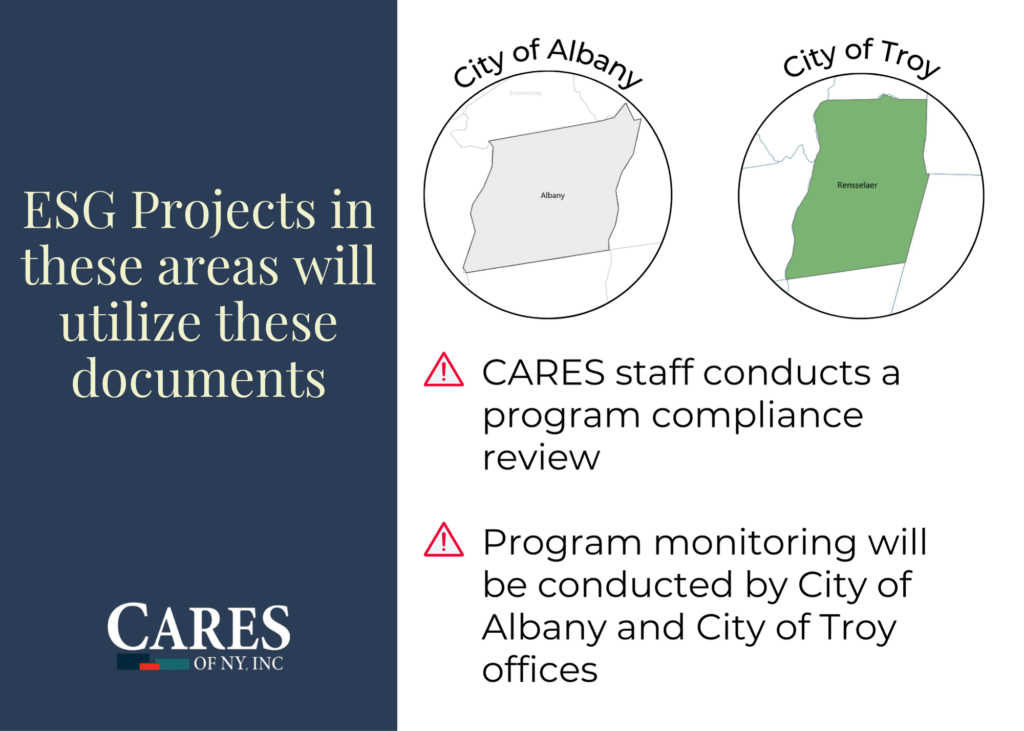
What are the Component Types for ESG?
Street Outreach
- Services related to reaching out to unsheltered homeless individuals and families, connecting them with emergency shelter, housing, or critical services, and providing them with urgent, non-facility-based care.
- Eligible costs: engagement, case management, emergency health and mental health services, transportation, and services for special populations. See 24 CFR 576.101.
- Eligible program participants: Individuals and families who qualify as homeless under paragraph (1)(i) of the “homeless” definition under 24 CFR 576.2.
Emergency Shelter
- Eligible costs: Renovation (including major rehabilitation or conversion) of a building to serve as an emergency shelter. The shelter must be owned by a government entity or private nonprofit organization and must serve homeless persons for at least 3 or 10 years, depending on the type of renovation and the value of the building.
- Essential Services, including case management, child care, education services, employment assistance and job training, outpatient health services, legal services, life skills training, mental health services, substance abuse treatment services, transportation, and services for special populations.
- Shelter Operations, including maintenance, rent, repair, security, fuel, equipment, insurance, utilities, food, furnishings, and supplies necessary for the operation of the emergency shelter. May include a hotel or motel voucher where no appropriate emergency shelter is available for a homeless family or individual.
- Eligible program participants: Individuals and families meeting the criteria of the “homeless” definition under 24 CFR 576.2.
Homelessness Prevention
- Housing relocation and stabilization services, and short-and/or medium-term rental assistance as necessary to prevent individual or family homelessness. Costs are eligible to the extent necessary to help the participant 4 regain housing stability in their current housing or move into other permanent housing and achieve stability.
- Eligible costs: Rental Assistance: rental assistance and rental arrears o Financial assistance: rental application fees, security and utility deposits, utility payments, last month’s rent, moving costs
- Services: housing search and placement, housing stability case management, landlord-tenant mediation, tenant legal services, credit repair
- Eligible program participants: Individuals and families who meet the criteria under the “at risk of homelessness” definition, or who meet the criteria in paragraph (2), (3), or (4) of the “homeless” definition in 24 CFR 576.2 and have an annual income below 30 percent of median family income for the area, as determined by HUD.
Rapid Rehousing
- Housing relocation and stabilization services and/or short-and/or medium-term rental assistance as necessary to help homeless individuals or families (living in shelters or in places not meant for human habitation) move as quickly as possible into permanent housing and achieve stability.
- Eligible costs: Rental Assistance: rental assistance and rental arrears
- Financial Assistance: rental application fees, security and utility deposits, utility payments, last month’s rent, moving costs
- Services: housing search and placement, housing stability case management, landlord-tenant mediation, tenant legal services, credit repair
- Eligible program participants: Individuals and families who meet the criteria under paragraph (1) of the “homeless” definition in 24 CFR 576.2 or who meet the criteria under paragraph (4) of the “homeless” definition and live in an emergency shelter or other place described in paragraph (1) of the “homeless” definition.
ESG Program Components Quick Reference_HUD Exchange
What is the difference between Emergency Shelter and Permanent Housing Property Standards for ESG?
- Emergency Shelter Standards: Shelters that receive ESG funds for renovation or shelter operations must meet the minimum standards for safety, sanitation, and privacy provided in §576.403(b). In addition, emergency shelters that receive ESG funds for renovation (conversion, major rehabilitation, or other renovation) also must meet state or local government safety and sanitation standards, as applicable.
- Permanent Housing Standards: The recipient or subrecipient cannot use ESG funds to help a program participant remain in or move into housing that does not meet the minimum habitability standards under §576.403(c). This restriction applies to all activities under the Homelessness Prevention and Rapid Re-housing components.
For further information please see: ESG Emergency Shelter and Permanent Housing Standards
What are key differences between RRH under ESG vs. CoC?
- Eligibility
- Eligible Use of Funds
- Services
Please see the link for further information: Rapid Re-Housing: ESG vs CoC
